Introduction
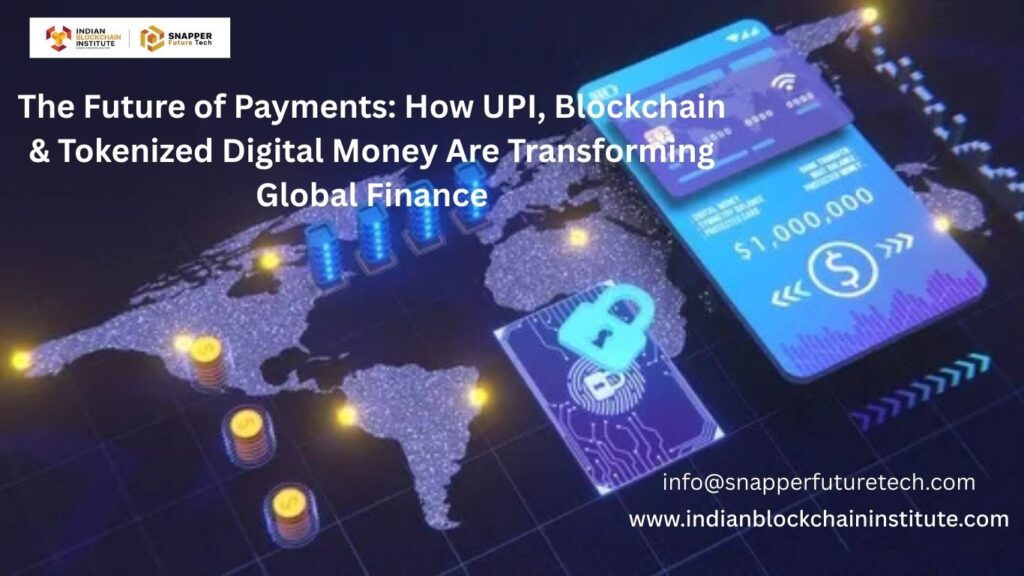
The payments industry is undergoing its most significant transformation in decades. What started with UPI revolutionizing instant payments in India has now expanded into a global movement toward blockchain-powered settlements and tokenized digital money. As governments, financial institutions, and enterprises embrace digital public infrastructure, the future of payments is poised to become real-time, programmable, interoperable, and borderless.
This article explores how UPI, blockchain, stablecoins, and CBDCs together form the foundation of next-generation financial systems.
UPI: Making Real-Time Digital Payments Mainstream
India’s Unified Payments Interface (UPI) has reshaped the global conversation around digital payments. With billions of transactions every month, UPI has proven that secure, instant, and free peer-to-peer transfers can operate at national scale.
Key Achievements of UPI
-
Real-time transfers available 24/7
-
Simple onboarding with mobile authentication
-
Merchant acceptance across offline and online channels
-
Financial inclusion through low-cost digital access
UPI laid the groundwork for consumer expectations: payments should be instant, seamless, and universally accessible.
Blockchain: Enabling Instant Settlement & Transparency
While UPI handles front-end payment experiences, blockchain solves back-end settlement challenges. Traditional banking rails rely on multiple intermediaries, clearing delays, and fragmented systems. Blockchain eliminates these inefficiencies by offering:
Blockchain Advantages
-
Real-time settlement without intermediaries
-
Immutable, tamper-proof transaction records
-
End-to-end transparency for regulators and institutions
-
Lower operational and reconciliation costs
This makes blockchain ideal for cross-border payments, treasury operations, securities settlement, and enterprise finance.
Tokenized Digital Money: The Next Big Shift
Digital money is evolving beyond simple account-based payments. The world is moving toward tokenized value, represented through:
-
Stablecoins (USDC, USDT, INR-backed tokens)
-
CBDCs (Central Bank Digital Currencies)
Tokenized digital money combines the stability of fiat currency with the efficiency of blockchain networks.
Why Tokenized Money Matters
-
Real-time atomic settlement
-
Programmability for automated transactions
-
Seamless global interoperability
-
Reduced fraud and increased traceability
Tokenized money unlocks new financial models that weren’t possible with traditional rails.
UPI + Blockchain: Unlocking Global Interoperability
The next era of payments lies in bridging domestic instant-payment systems like UPI with global blockchain networks. When these systems interconnect:
-
Cross-border payments become instant and low-cost
-
Value moves without legacy banking delays
-
Financial institutions gain unified settlement infrastructure
-
Merchants receive payments in real time, internationally
This interoperability represents a massive leap toward a unified digital economy.
Programmable Payments: Automating Business Workflows
One of the biggest breakthroughs of blockchain and tokenized money is programmability. Payments will no longer be static transfers—they will become intelligent, automated workflows.
Example Use Cases
-
Automated vendor payouts
-
Conditional loan disbursements
-
Smart contract-driven payroll
-
Milestone-based supply-chain payments
-
Government subsidies with built-in compliance
Programmable payments reduce manual processes, eliminate delays, and bring transparency to every transaction.
Governments & Enterprises Are Building Unified Digital Public Infrastructure
Countries worldwide are adopting digital public infrastructure (DPI)—integrated systems combining identity, payments, data exchange, and digital money.
Countries like India are pioneering Digital Public Infrastructure (DPI) with layers of identity (Aadhaar), payments (UPI), and data (DigiLocker). The next evolution includes:
Enterprises are also investing in:
-
Tokenization platforms
-
CBDC pilots
-
Blockchain-based settlement layers
-
Cross-border payment networks
The result is a future where financial services are seamless, efficient, secure, and globally connected.
Large enterprises are also exploring tokenization of assets, on-chain finance, and real-time treasury management.
Conclusion: The Future of Money Is Real-Time, Tokenized & Borderless
We are witnessing a historic shift in global finance.
UPI has shown what frictionless payments can achieve.
Blockchain brings settlement finality and transparency.
Stablecoins and CBDCs introduce programmable, tokenized digital money.
Together, these technologies will power a financial system where money moves instantly, securely, globally, and autonomously.
This is not the distant future — it is unfolding now.
The next decade will belong to platforms and institutions that embrace this transformation.