
Introduction
As artificial intelligence continues to permeate every aspect of modern life — from healthcare systems and financial institutions to marketing strategies and logistics — new concerns have surfaced around data privacy, algorithmic bias, and centralized control. Enter Decentralized AI (deAI) — a next-generation concept that merges the computational power of AI with the security and transparency of blockchain technology.
Decentralized AI is rapidly emerging as a pivotal innovation in the Web3 era, ensuring fairness, security, and inclusivity in AI-driven systems. Let’s explore how deAI works and why it represents a vital step forward for industries globally.
Key Advantages of Decentralized AI (deAI)
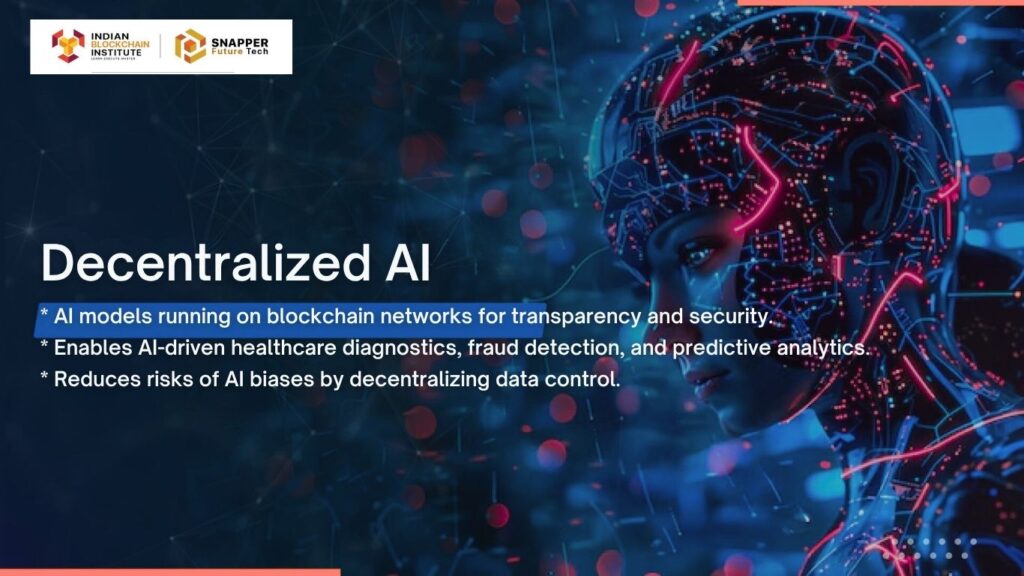
🔐 AI Models Running on Blockchain Networks for Transparency and Security
One of the core benefits of decentralized AI is its ability to operate AI models directly on blockchain-powered networks. Unlike conventional AI systems hosted on centralized servers, deAI decentralized control and governance across distributed nodes.
Benefits include:
- Immutable, transparent audit trails for AI decision-making processes.
- Enhanced data privacy and security, eliminating single points of failure.
- Real-time, decentralized verification of AI model updates and data integrity.
This level of transparency ensures users and enterprises can trust AI predictions and actions in mission-critical industries like finance, healthcare, and cybersecurity.
🏥 Enabling AI-Driven Healthcare Diagnostics, Fraud Detection, and Predictive Analytics
Decentralized AI isn’t just a theoretical concept — it’s already revolutionizing key industries by offering scalable, secure, and ethical AI services.
Healthcare Diagnostics
- Facilitates secure, privacy-preserving sharing of sensitive medical data.
- Allows decentralized AI models to assist in diagnosing diseases with enhanced accuracy and without exposing patient information.
- Encourages cross-institutional collaboration while maintaining individual data ownership.
Fraud Detection
- Real-time fraud detection through decentralized networks.
- Prevents manipulation by central authorities and ensures transparent reporting.
- Creates tamper-proof logs of flagged transactions and security breaches.
- Decentralized AI systems monitor financial transactions in real-time.
- Detects anomalies and fraud patterns without relying on single-entity oversight.
- Reduces financial fraud risks through transparent, tamper-proof decision logs.
Predictive Analytics
- Accurate forecasting in industries like e-commerce, logistics, and finance.
- AI models trained on decentralized, diverse datasets reduce biases and improve reliability.
- Ensures equitable access to predictive insights without monopolized control.
- AI models forecast trends, demand, and behavior patterns across decentralized data networks.
- Ensures data integrity and unbiased predictive outcomes.
- Enhances efficiency in industries like logistics, finance, and e-commerce.
⚖️ Reduces Risks of AI Biases by Decentralizing Data Control
A persistent issue in AI systems is algorithmic bias, often resulting from centralized, non-representative, or manipulated data sources. Decentralized AI tackles this challenge head-on by redistributing data control to a network of global participants.
Key benefits:
- Diverse, decentralized data inputs improve the representativeness of AI models.
- Transparent governance mechanisms allow communities to vet and approve datasets.
- Minimizes the risk of biased or discriminatory AI outputs caused by skewed data.
By decentralizing control, deAI promotes fairness, inclusivity, and ethical decision-making in AI applications.
Why Decentralized AI Matters for the Future
The convergence of AI and blockchain through deAI represents more than just a technological evolution — it marks a cultural and operational shift toward transparency, fairness, and decentralized empowerment. As AI becomes central to critical systems like public health, digital finance, and government services, decentralizing its infrastructure is crucial for ensuring ethical practices and safeguarding public trust.
Conclusion
Decentralized AI (deAI) represents a crucial evolution in the world of artificial intelligence, merging the strengths of blockchain’s transparency and security with AI’s predictive power. From improving healthcare diagnostics and financial fraud detection to ensuring ethical predictive analytics, deAI empowers industries to adopt AI with confidence.
Most importantly, by redistributing data control and governance, decentralized AI reduces systemic biases, bolsters trust, and supports more equitable AI outcomes. As Web3 continues to expand, deAI is poised to become a cornerstone technology for secure, transparent, and bias-free AI ecosystems.